
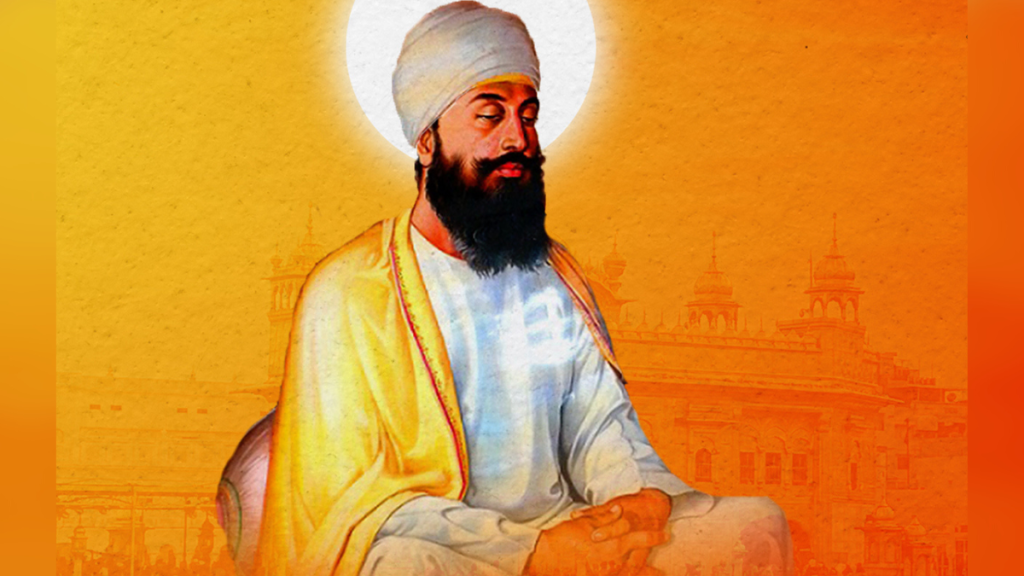
Guru Teg Bahadur and the Hindu-Rashtra

Author – Dr JasSimran Kehal

Dr JasSimran Kehal
The Right to freedom of religion was implemented in India in 1950. Article 25-28 of the Indian constitution provides the right to freely profess, practice, and propagate one’s religion. It not only prohibits the state to use public funds to promote any particular religion but also prevents religious instructions in state-funded educational institutions. Globally, Article 18 of the Universal Declaration of Human Rights adopted as late as 1948 guarantees freedom of religion to all the individuals. But still, many countries like North Korea, Saudi Arabia, Iran, China etc. have worst religious freedom and only about 120 countries constitutions mention religious equality.
It is this freedom to practice religion of choice for which Sri Guru Teg Bahadur set an exemplary example and that too almost 275 years prior to this right being made a constitutional and legal obligation. In fact, his life journey from Teg-Mal to Teg-bahadur, Teg-bahadur to Guru Teg Bahadur and further as a Martyr shattered the dream of Aurungzeb, the oppressor, to establish in India the concept of Dar-ul Islam. His martyrdom not only challenged and ended the label of Dar ul Harb given to the Indian subcontinent by the Mecca clerics but also led to decline of Mughal Empire.
As various religious, political as well as government organizations are commemorating 350th anniversary of Guru Teg Bahadur’s martyrdom, there are some genuine questions for historians and social scientists arising in my mind. Although, cross-questioning religious dogmas and beliefs is not the convention but being a Sikh it is my duty to do so. After all, Guru Nanak questioned at Haridwar, Mecca and Kabir unequivocally put Mullah as well as Pandit in the same dock.
First of all why did the Kashmiri Pandits go to Guru Teg Bahadur to save Hinduism in spite of the fact that the previous gurus had already rejected Hindu scriptures like the Vedas? Did the pandits go to the ninth Guru at the first place or after being turned out by Hindu kings? It is worth mentioning here that around those times Deccan was under the ever so powerful Maratha rule, Mewar was ruled by Rajput kings and the nearby Jammu was governed by Hindu Jamwal ruler Raja Hari Dev.
It is also a matter of research that were Kashmiri pandits the only reason for the arrest /surrender of ninth Guru? Or there were some other previous contributing factors which led to the torture and ultimate death of Guru Teg Bahadur and his associates. In fact, the Guru was also arrested ten years earlier on 8th November, 1665 and Aurangzeb had ordered Guru’s execution. But the Guru was released after about 2 months after the assurance of Prince Ram Singh of Jaipur.
Poet Sainapati was one of the 52 poets in Guru Gobind Singh’s court. In his writing SRI GUR SOBHA, he describes the ninth guru as:-
प्रकट भयो गुरु तेग बहादुर, सगल सृष्टि पर ढाांपी चादर।
PRAGAT BHAYE GURU TEG BAHADUR, SAGAL SRIST PE DHAPI CHADAR.
In this verse, coined about a decade or two after the ninth Guru’s execution, Guru Teg Bahadur is being given the status of savior of the whole universe.
It is also a matter of investigation that where did the term Hind Di Chaadar come from? When and why was the Guru downgraded from a universal savior to a geographical limit? In those times Hind as a geographical identity extended from Afghanistan to Burma. As of now the limits have diminished. Does that mean that the Hind di chaadar is shrinking?
And if Hind di Chaadar is being attributed to Hinduism as a religion and Guru Teg bahadur as its savior, there is some serious soul searching to be done. If that is the case then there are many more questions that arise.
How and when this phrase ‘Hind Di Chaadar’ did come into being? Who coined these words and in which writing was it first published? Isn’t it like a planned ploy to bring the Gurus under Hindutva umbrella and place them alongside thirty three crore deities. And once the narrative is established that the gurus died protecting Hinduism, it won’t be difficult to bring masses under the Hindu fold.
If Guru Teg Bahadur had been professing in today’s era of Hindu majoritarian supremacy in which Muslims are being treated as second rung citizens, subjected to daily insults and atrocities in the name of religion with daily instances of being forced to chant Jai Shri Ram, what would have been the Guru’s response? Similarly, if the Guru had been dwelling at the times when lakhs of Buddhist monks were being beheaded and academic places demolished, for whom would the Guru be spreading his Chadar?
Dr Ambedkar had grave concerns about the ‘tyranny of the majority’ and considered it as a fundamental threat to genuine democracy. Guru Teg Bahadur’s life struggles are aimed towards establishing socio-religious democracy. From his courageous act of waging the sword at the tender age of 14 at the battle of Kartarpur against Mughal warrior Painda Khan to composedly facing the sword of his executioner Jallal-ul-Din Jallad at 54 year age, the ninth Sikh Guru was acting against the same tyranny which Ambedkar was afraid of.
Is it necessary to remain throughout life in the same religion as that of one’s birth? Guru Nanak didn’t think so. The first Guru denounced Hindu practices and started a different cult which ultimately culminated in the formation of a new religion by the tenth Guru. Guru Granth Sahib has on enormous counts condemned and criticized orthodox Hindu as well as Muslim practices. It is hard to digest that the sole reason of martyrdom of the ninth Guru was to the save the same religion which the previous and the subsequent guru revolted against.
In fact, Guru Teg Bahadur was a protector of human rights who was crystal clear in his vision about religious conversion. What he fought against was the forced-conversion and what he was in favor of was voluntary-conversion. The second type of conversion was practiced by his own son when he baptized five into Sikh religion. Those first five were from different parts of united India – Lahore, Delhi, Jagannath Puri, Dwarka and Bidar. Millions followed them by voluntary conversion to establish one of the youngest religions of the subcontinent.
350 years down the line after the supreme sacrifice of Guru Teg Bahadur which he laid definitely not to protect a singular religion but to establish the free will to practice the religion of
one’s choice, echoes of Hindu-Rashtra reverberate. The majoritarian atmosphere being built up looks down upon the other religions with minority 15% and 2% population. The 15% group is being vilified while the 2% is being discreetly subverted. Some even say that the 2% group is the armed battalion of the Hindus. Any voluntary-conversion is also being termed as Jihad.
In today’s scenario, the Guru Teg Bahadur would have protected the rights of not only those who wanted to profess, practice or preach their own theology but would have also stood for atheists who count for about 1/10th population in this globe. As far as Hindu-Rashtra is concerned, he would have fought tooth and nail against the evil designs of the majority with the same passion as he stood against Dar-ul Islam. Terming the great Guru as a protector of a single faith amounts to belittling his supreme sacrifice and smacks of a scheme to subvert Sikhism.
Author bio – Dr. Jas Simran Kehal, MBBS, MS (Ortho), has an MA in Journalism and Mass Communication and an MA in Ambedkar Thought.

+ There are no comments
Add yours