
Beating Brahminism The Way 500 Soldiers of Bhima Koregaon Did

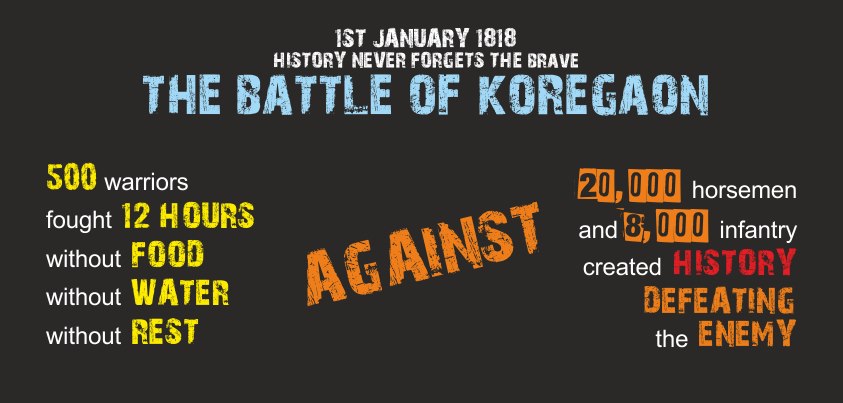
For most of the world, January 1 represents the start of a new calendar year. But for the Dalit-Bahujan community in India, January 1 is Shaurya Din (Day of Valour). It marks the anniversary of the Battle of Bhima Koregaon (1818), where 500 soldiers of the Mahar community, fighting under the British East India Company, delivered a crushing blow to the 28,000-strong army of Peshwa Baji Rao II.
This was not merely a military skirmish between a colonial power and a local kingdom. It was a war of liberation—a historic reckoning where the oppressed took up arms against the very architects of their degradation. To understand the victory of the 500 is to understand the blueprint for beating Brahminism today.
The Context: Life Under the “Broom and Pot”
To appreciate the victory, one must first understand the “Peshwai”—the rule of the Brahmin Peshwas in Maharashtra. Under this regime, Brahminism was not just a social ideology; it was the law of the land, enforced with clinical cruelty.
The Mahars, an untouchable but historically martial community, were subjected to the most dehumanizing restrictions recorded in human history:
-
The Broom: Mahars were forced to tie a broom to their waists so that their “polluted” footprints would be swept away as they walked.
-
The Pot: They were forced to hang an earthen pot around their necks to catch their spittle, ensuring it didn’t “pollute” the ground where a Brahmin might step.
-
The Shadow: They were forbidden from entering the city of Pune during the morning and evening hours because their long shadows might accidentally touch and “defile” an upper-caste passerby.
The Peshwai was the physical manifestation of the Manusmriti. It was a system that sought to kill the spirit of a people before it ever touched their bodies.
The Battle: 500 vs. 28,000
On New Year’s Eve, 1817, a small battalion of the 2nd Battalion, 1st Regiment of Bombay Native Infantry—comprising roughly 500 Mahar soldiers and a few hundred others—marched 25 miles from Shirur to Pune. They were exhausted, hungry, and thirsty. Upon reaching the banks of the Bhima River at Koregaon, they found themselves staring at the massive encampment of the Peshwa’s army: 20,000 cavalry and 8,000 infantry.
The odds were nearly 56 to 1.
However, the Mahars weren’t just fighting for a British paycheck; they were fighting for their right to exist. Legend has it that before the battle, the Mahar leader Sidnak Mahar approached Baji Rao II, offering the community’s loyalty to the Maratha Empire if the Peshwa would end the practice of untouchability. The Peshwa’s response was a typical Brahminical insult.
The Mahars turned back to the battlefield with a clear realization: the British were a temporary colonial presence, but the Peshwai was an eternal prison. To break the prison, they had to destroy the jailer. For 12 grueling hours, the 500 held their ground in the village of Koregaon. They fought from house to house, street to street, and eventually forced the superior Peshwa forces to retreat. The “invincible” Brahminical empire had been humbled by those it considered “unfit to touch.”
Babasaheb’s Reclamation of Memory
For a century, the battle was recorded merely as a British military victory. It was Dr. B.R. Ambedkar who, on January 1, 1927, visited the Vijay Stambha (Victory Pillar) and transformed it into a site of radical Dalit memory.
Babasaheb recognized that the history of the Mahars at Bhima Koregaon was the perfect antidote to the “myth of merit” and the “myth of weakness” propagated by Brahminism. He used the pillar to remind the community that:
-
They were naturally martial: Their ancestors were warriors, not “menial laborers” by choice.
-
Organization is Power: 500 organized, disciplined men could break the back of a disorganized, arrogant empire of 28,000.
Beating “Neo-Peshwai” in 2025
Today, we witness the rise of what activists call the Neo-Peshwai. While the broom and the pot have largely disappeared from the streets, they have moved into the institutions. The exclusion of Bahujans from the judiciary, the corporate world, and mainstream media is the modern equivalent of the “long shadow” rule.
How do we apply the lessons of the 500 today?
-
Refuse the Inferiority Complex: The 500 did not believe they were “untouchable” or “inferior.” They knew they were superior in grit and skill. We must reclaim our intellectual and cultural history to fight the manufactured inferiority of the current system.
-
Strength in Discipline: The Peshwa’s army was large but fractured by internal hierarchies. The 500 were a cohesive unit. In the digital age, a small, well-organized group of “cyber-soldiers” on platforms like Velivada can disrupt massive Brahminical narratives.
-
Political Assertion over Religious Subservience: The 500 chose the battlefield over the temple. They prioritized their dignity over a religion that didn’t want them. True liberation lies in political and social assertion, not in trying to “fit into” a hierarchy designed to keep you at the bottom.
Bhima Koregaon is not just a story of the past; it is a prophecy. It tells us that no matter how large the opposition, no matter how many thousands of years an oppressive system has stood, it can be dismantled in a single day of focused, collective action.
The 500 soldiers didn’t just win a battle; they killed an ideology. As we gather every January 1, we don’t just mourn the dead—we celebrate the death of the Peshwai and the birth of a new, assertive Dalit-Bahujan consciousness.

+ There are no comments
Add yours