
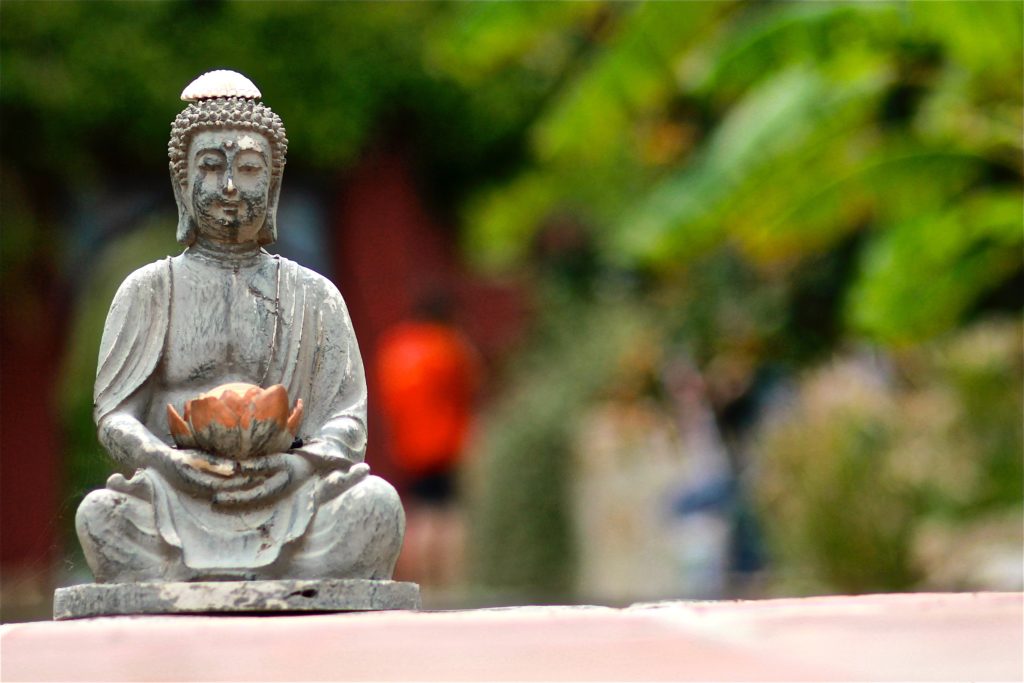
Buddha Against Caste And When Did Buddha Become An Avatar Of Vishnu

All that the Brahmanic theory of Avatar says is that God saves his followers by taking different forms although God may be very impure and immoral in his conduct. – Dr Ambedkar in ‘The Buddha and His Dhamma’
You must have heard it a million times that Brahmins propagate that the Buddha is an avatar of Vishnu, the Hindu God. But when did Buddha become so? How did he become an avatar of Vishnu? As a simple matter of fact, Buddha was not an avatar of Vishnu, no matter what Brahmins tell you. Brahmins want to appropriate Buddha and include him into their millions of Gods.
So, when did Buddha become an avatar of Vishnu? During Buddha’s time, Brahmins had to yield in and make changes to the caste system. Dr Ambedkar writes that Bhagwat Gita was written by Brahmins as the response to the challenge thrown by Buddhism. Further, Dr Ambedkar also wrote in the Riddles in Hinduism that the reason there are so many Hindu Gods is that when the popularity of one of their created gods declined, Brahmins invented another one. So, continuing the same tradition of appropriation and filling their potbellies, Brahmins must have included Buddha also among their avatars.
Dr Ambedkar writes that Buddha was the greatest opponent of Chaturvarna system. Dr Ambedkar said,
He [Buddha] was the greatest opponent of Chaturvarna. He not only preached against it, fought against it, but did everything to uproot it.
According to Hinduism neither a Shudra nor a woman could become a teacher of religion nor could they take Sannyasa and reach God. Buddha on the other hand admitted Shudras to the Bhikkhu Sangha. He also admitted women to become Bhikkhunis. Why did he do so?
Buddha wanted to take concrete steps to destroy the gospel of inequality.
Buddhist Texts Against Caste
At the time of Buddha, the caste system was as rampant as it is today. From Buddhist scriptures and books one can find ample evidence of mentioning of caste system practised by Brahmins – touch, shadow or even the wind coming from the side where “chandala” is standing is considered impure – one can find many such descriptions in Buddhist books such as Jataka tales.
Canonical Buddhist literature repeatedly confronts Brahmanical caste ideology. The Vasala Sutta (Sutta Nipāta 1.7) famously declares:
Na jaccā vasalo hoti,
Na jaccā hoti brāhmaṇo;
Kammunā vasalo hoti,
Kammunā hoti brāhmaṇo.
(“Not by birth is one an outcaste, not by birth is one a Brahmin; by deeds one becomes an outcaste, by deeds one becomes a Brahmin.”)
This verse directly inverts Brahmanical logic. Moral action (kamma), not birth (jati), determines worth.
The Buddha also mocked Brahmanical claims to racial and ritual purity, pointing out that sexual reproduction, not divine origin, produced Brahmins like everyone else (Assalāyana Sutta, Majjhima Nikāya 93).
Buddhism as a Threat to Brahmanical Order
It is precisely because Buddhism posed such a profound challenge that Brahmanism was forced to respond. Ambedkar argued that major Brahmanical texts – including the Bhagavad Gita – should be read as counter-revolutions against Buddhism, reasserting varna under the guise of duty (dharma) and devotion (bhakti) (Ambedkar, Riddles in Hinduism).
Over time, as Buddhism gained mass support – especially among lower castes and women – Brahmanism adopted multiple strategies: philosophical refutation, institutional marginalisation, and finally, theological appropriation. One such strategy was to absorb the Buddha into the Hindu pantheon itself.
The Late Inclusion of the Buddha in the Dashavatar
Early Hindu texts do not list the Buddha as an avatar of Vishnu. In older traditions, Balarama occupies a place in the avatar lists. It is only in later Puranic and regional traditions – especially in North India – that the Buddha appears as the ninth avatar, replacing Balarama.
This substitution is historically significant. It coincides with the period when Buddhism was declining institutionally but remained influential ethically and philosophically. By rebranding the Buddha as a Vishnu avatar, Brahmanism could claim Buddhism’s moral authority without surrendering caste hierarchy.
Some Puranic texts even portray the Buddha as a deceptive avatar sent to mislead demons – hardly a mark of reverence. This ambivalence reveals that the inclusion was not an act of respect, but of containment.
To describe this process as “inclusion” is misleading. Inclusion implies equality. What occurred instead was subsumption – the neutralisation of a radical anti-caste philosophy by reframing it within a system it fundamentally opposed.
Ambedkar was clear on this point: Hinduism has historically multiplied gods not out of pluralism, but as a mechanism to manage dissent. When one doctrine loses authority, another is invented or absorbed. The Buddha’s incorporation follows this pattern.
Importantly, Buddhism does not recognise avatars, nor does it accept the authority of the Vedas or the legitimacy of caste. To call the Buddha an avatar of Vishnu is therefore not a Buddhist claim; it is a unilateral Brahmanical one.

+ There are no comments
Add yours