
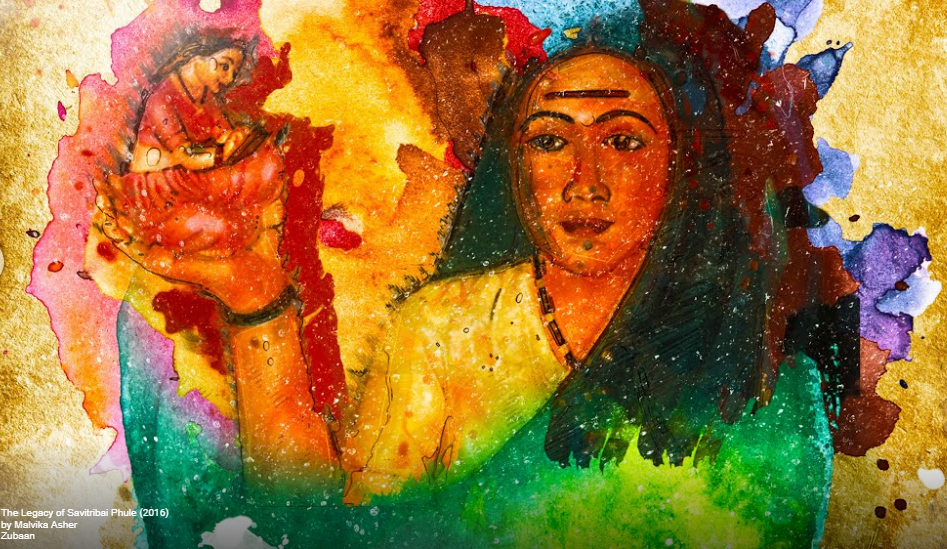
The Mother of Indian Feminism: A Life Sketch of Savitribai Phule (1831–1897)

In the pantheon of India’s social reformers, few names shine as brightly – or were as fiercely opposed in their time – as Savitribai Phule. Savitribai was a radical anti-caste intellectual, a poet of resistance, and a tireless crusader for the oppressed. While the mainstream narrative often forgets to remember her, her life was a continuous battle against the mindset that sought to deny education and dignity to Shudras, Ati-Shudras, and women. As we revisit her timeline, we are not just looking at dates; we are looking at the milestones of India’s first true feminist movement.
The Early Years: Seeds of Revolution (1831–1847)
Savitribai was born on January 3, 1831, in the village of Naigaon in Satara district, Maharashtra. Born into the Mali community (an OBC caste), she grew up in a society where education for women and lower castes was considered a religious sin.
-
1840: At the age of nine, she was married to Jyotirao Phule, who was then 13. This union would become one of the most powerful partnerships in human history. Unlike traditional marriages of the time, theirs was an intellectual and revolutionary alliance.
-
Education begins: Jyotirao, having realized that “lack of education leads to lack of wisdom,” began teaching Savitribai at home. She quickly grasped the power of literacy, understanding that the Brahminical monopoly on knowledge was the root cause of people’s slavery.
The Historic First School (1848)
The year 1848 marks a watershed moment in Indian history.
-
January 1, 1848: At Bhide Wada in Pune, Savitribai and Jyotirao opened India’s first school for girls. It started with just nine students.
-
The Backlash: The orthodoxy in Pune was furious. Men would wait on the streets to throw cow dung, mud, and stones at Savitribai as she walked to school. She would calmly carry an extra sari in her bag, change upon reaching the school, and continue teaching.
Expanding the Movement (1849–1855)
The Phules did not stop at one school. They realized that the “lower” castes needed their own institutions to break free from mental slavery.
-
1849: They started a school for adults, specifically for the Usman Sheikh and Fatima Sheikh families, who had given them shelter when Jyotirao’s father evicted them from their home under pressure from orthodox Brahmins. Fatima Sheikh became Savitribai’s lifelong colleague and stands as India’s first Muslim woman teacher.
-
1852: The British government honored Savitribai as the “Best Teacher.” By this time, the Phules were running three schools with nearly 150 students – outperforming the government schools in both enrollment and quality.
-
1854: Savitribai published Kavya Phule (Poetry’s Blossoms), a collection of poems that urged the Bahujan samaj to get educated and overthrow the yoke of caste.
Social Radicalism Beyond Education (1860s–1870s)
Savitribai’s work extended far beyond the classroom. She targeted the cruel social customs that enslaved women.
-
1863: The Phules started the Balhatya Pratibandhak Griha (Home for the Prevention of Infanticide) in their own house. This was a refuge for pregnant Brahmin widows who were often sexually exploited and then forced to abort or kill their babies to hide “shame.” The Phules adopted one such child, Yashwant, raising him as their own.
-
1868: In a direct challenge to the caste notion of pollution, Savitribai threw open her personal water tank to the “untouchables” (Dalits), declaring that water belongs to everyone.
-
September 24, 1873: The Satyashodhak Samaj (Truth Seekers’ Society) was founded. Savitribai was the head of the women’s wing, organizing women to reject Brahmin priests for marriages and religious ceremonies.
The Final Years: Sacrifice and Legacy (1890–1897)
After Mahatma Jyotirao Phule passed away in 1890, Savitribai took over the leadership of the Satyashodhak Samaj. In a defiance of all patriarchal norms, she lit her husband’s funeral pyre – an act unheard of for a woman in the 19th century.
-
1893: She presided over the Satyashodhak conference at Saswad, guiding the movement through a critical transition.
-
1896-1897: The Bubonic Plague hit Pune. While the elites fled the city, Savitribai and her son Yashwant (now a doctor) opened a clinic to treat the sick.
-
The End: In March 1897, Savitribai carried a plague-stricken boy on her back to the hospital. In the process, she contracted the disease herself. She passed away on March 10, 1897, dying as she lived – in the service of humanity.
Why We Remember Her Today
Savitribai Phule was not just a reformer; she was a nation-builder. She understood that a nation cannot be free if its women and workers are enslaved by caste and ignorance.
As we look at her life sketch on Velivada, we are reminded that the pen is indeed mightier than the sword, but only if that pen is used to write the truth. Her life is a timeline of courage, a roadmap for every Ambedkarite and feminist today.
Educate, Agitate, Organize.
Jai Bhim! Jai Savitri!

+ There are no comments
Add yours