
How Caste Structures India’s Entrepreneurial Ecosystems

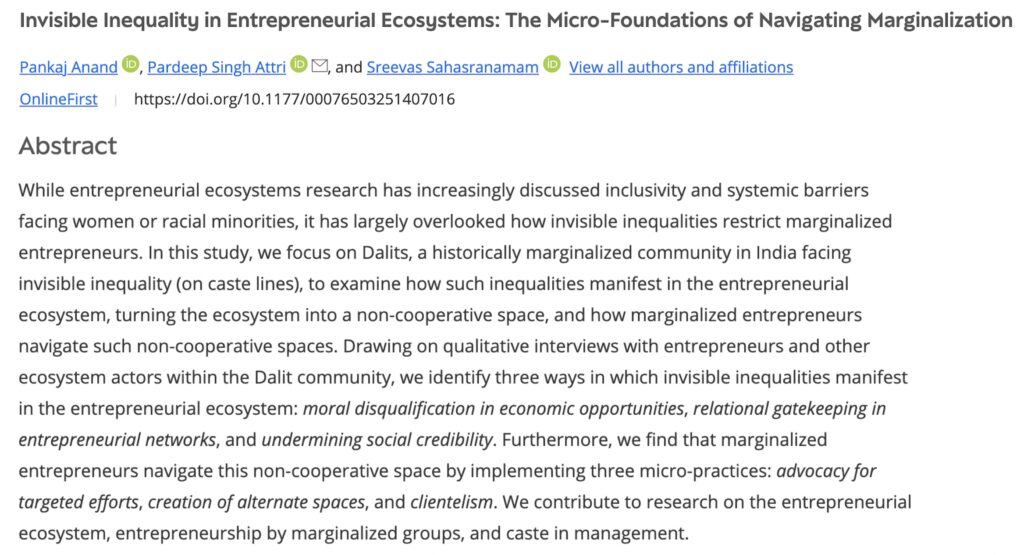
The prevailing narrative of the modern Startup India era is one of boundless opportunity. We are told that in the digital age, the entrepreneurial ecosystem is a meritocratic, neutral support system where anyone with a good idea can thrive. However, a recent study titled “Invisible Inequality in Entrepreneurial Ecosystems: The Micro-Foundations of Navigating Marginalization” reveals a much darker reality for those on the margins.
By focusing on the lived experiences of Dalit entrepreneurs – a community that has faced systemic social exclusion for millennia – researchers Pankaj Anand, Pardeep Singh Attri, and Sreevas Sahasranamam expose how deep-seated, invisible inequalities transform supposedly supportive ecosystems into “non-cooperative spaces”.
The Myth of Ecosystem Inclusivity
Research often assumes that ecosystems benefit all actors equally. While there has been increasing discussion about barriers facing women or racial minorities, the role of caste – an invisible inequality that cannot be seen from physical features but can be inferred through surnames and social norms – has remained largely ignored in management literature.
For Dalits (historically referred to as untouchables and positioned outside the traditional four-varna system), the ecosystem does not function as a neutral engine of growth. Instead, it acts as a hostile environment that reproduces exclusion through informal codes and systemic misrecognition.
How Invisible Inequalities Manifest
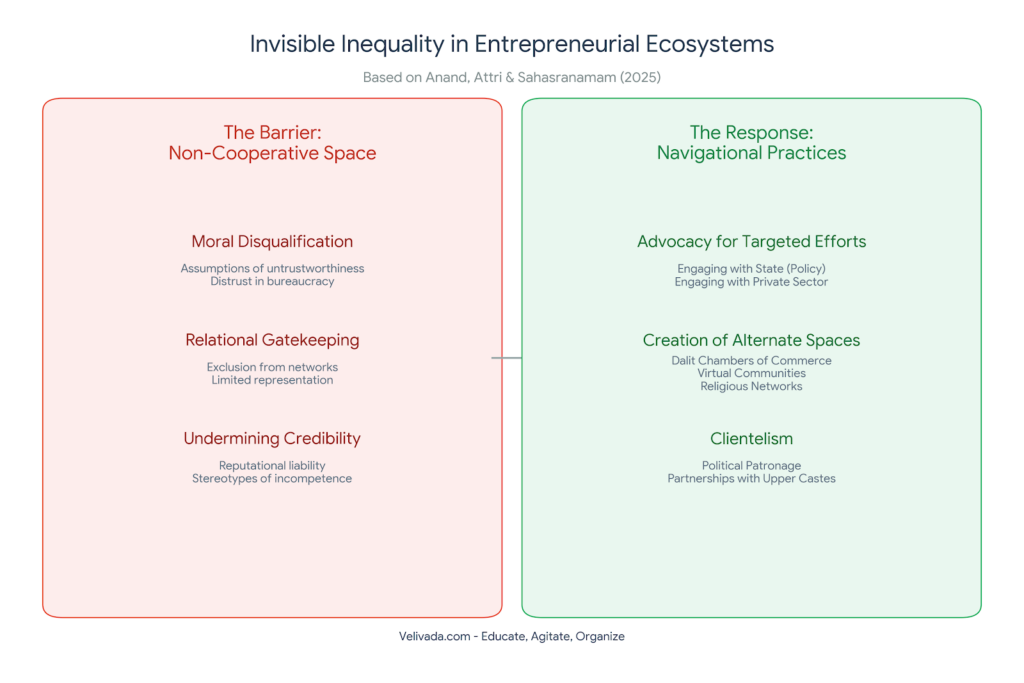
The research identifies three specific ways that invisible inequalities manifest, turning the entrepreneurial ecosystem into a non-cooperative space.
1. Moral Disqualification in Economic Opportunities
Access to capital is often framed as a matter of economic efficiency or business merit. For Dalit entrepreneurs, however, it is governed by an invisible caste calculus.
-
Assumptions of Untrustworthiness: Loan officers frequently presume Dalits are financially irresponsible or likely to default. Bankers interviewed admitted that a hidden mindset exists where loans to Dalits are viewed as riskier, regardless of the quality of the business proposal.
-
Bureaucratic Obstruction: Dalits face disproportionately complex loan conditions, such as requirements for substantial collateral or multiple guarantors that government regulations do not actually specify.
-
Land Exclusion: Upper-caste owners often refuse to sell land to Dalits once their identity is revealed, using land as a tool to maintain historical dominance.
2. Relational Gatekeeping in Networks
Ecosystems rely on relational infrastructure – informal gatherings, social clubs, and peer networks where deals are initiated and information is shared.
-
Social Exclusion: Dalit entrepreneurs are frequently excluded from the rooms where it happens. They are often not invited to the social gatherings where crucial business connections are forged.
-
Tokenism and Silencing: Even when invited, they are often treated as “tokens” to showcase diversity but are dismissed or silenced when attempting to contribute meaningful expertise.
-
Industry Association Dominance: Mainstream business associations are often dominated by upper-caste networks that prioritize their own. High membership fees and opaque sponsorship requirements act as further gatekeeping mechanisms.
3. Undermining Social Credibility
Social credibility – the degree of trust a person commands – is structurally caste-bound.
-
Reputational Liability: Caste identity functions as a liability. There is a persistent, unfounded belief that products made by Dalits are of inferior quality or that their businesses are unprofessional.
-
The Benefit Seeker Stereotype: When accessing government schemes, Dalit entrepreneurs are often viewed with suspicion by officials as mere benefit seekers looking for free money.
-
Corruption as a Caste Tax: Because they are seen as soft targets without dominant-caste patronage, Dalits are often pressured into paying unofficial “fees” or bribes to move their applications through the bureaucracy.
Navigating the “Non-Cooperative” Space
Dalit entrepreneurs are not merely passive recipients of discrimination; they are resilient agents who have developed distinct micro-practices to navigate this hostile terrain.
Practice 1: Advocacy for Targeted Efforts
Entrepreneurs engage in caste-conscious advocacy, demanding frameworks that recognize caste as a foundational barrier rather than a generic business challenge.
-
State Engagement: Advocacy led to landmark policies, such as the mandate for the state government to source a percentage of procurement specifically from Dalit and Adivasi-owned businesses.
-
Corporate Pressure: By engaging with the private sector, they have secured commitments from major groups such as Tata to invest in Dalit enterprises, providing both capital and symbolic legitimacy.
Practice 2: Creation of Alternate Spaces
Recognizing their exclusion from mainstream networks, Dalit entrepreneurs have built their own parallel institutional structures.
-
Founding Dalit Chambers: Organizations like the Dalit Indian Chamber of Commerce and Industry (DICCI) provide a voice in policy-making and essential support systems.
-
Virtual Communities: Online platforms like WhatsApp groups have become safe spaces to share advice, resources, and failures without the caste-coded humiliations found in physical elite circles.
-
Religious and Global Links: Some entrepreneurs leverage religious networks, such as Buddhist organizations, to connect with international markets (like Japan), effectively bypassing local caste-stratified domestic markets.
Practice 3: Strategic Clientelism
This involves building tactical relationships with political figures and dominant-caste actors to secure protection and resources.
-
Political Patronage: Entrepreneurs established rapport with local ministers to resolve land disputes or reduce bureaucratic harassment.
-
Brahminical Fronting: In some instances, Dalit entrepreneurs strategically hire upper-caste employees for top management or client-facing roles to provide instant credibility and break through business barriers.
The research makes it clear: When an ecosystem ignores caste, it doesn’t become neutral; it defaults to the existing power structures of the dominant caste. The annihilation of caste within the business world requires intentionality. Until the invisible walls of moral disqualification and relational gatekeeping are dismantled, the promise of an egalitarian entrepreneurial revolution will remain just that – a promise for the few, and a barrier for the many.

+ There are no comments
Add yours