
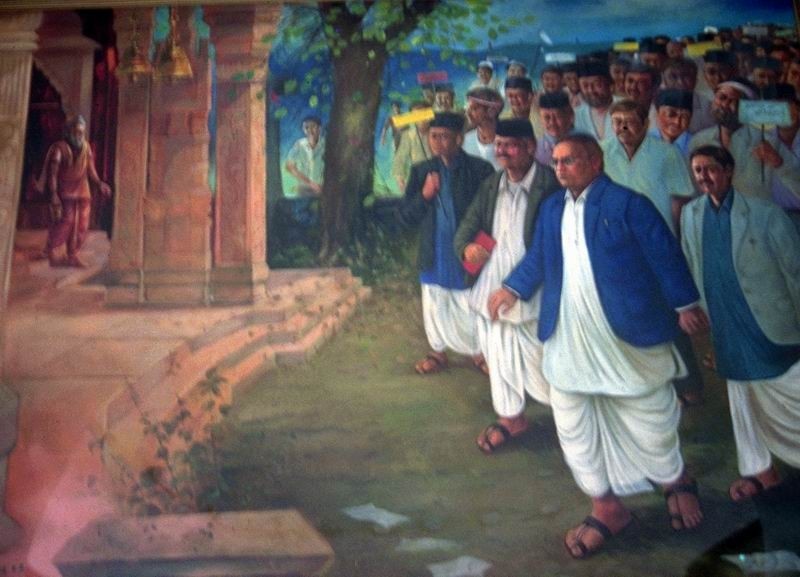
Babasaheb Ambedkar – The Power of Procession

Author – Dr. Mukesh Sablania, Lecturer (Political Science), Andhra Education Society, New Delhi
Born on April 14, 1891, Dr. Bhimrao Ramji Ambedkar was a visionary leader who fought for the rights of the underprivileged and was instrumental in forming the social and legal structures of contemporary India. Being the primary drafter of the Indian Constitution, Dr. Ambedkar, in addition, is regarded as a resolute social reformer, philosopher, and jurist who devoted his life to ending caste-based discrimination and uplifting the downtrodden.
14th April is not mere a date on the calendar but it has become a character of courage, commitment, unity and perseverance among the Dalit community across the globe. Celebrated as Ambedkar Jayanti every year this day has come out as evidence of his lasting influence. Hardly any political figure in India exists who is celebrated through the rallies by public with great excitement and enthusiasm than Dr. Ambedkar’s. Slogans of ‘Long Live Ambedkar’ and ‘Jai Bheem’ are commonly heard among the crowd with blue flags in the hands of few and others carrying posters of Ambedkar depicting his huge stature in western attire.
As a social reformer he fought against the evil practice of untouchability and raised demands for the equal rights for the marginalized groups in India. In order to attain success, he used a variety of tactics in his fight for justice, but one effective and frequently overlooked one was the employment of public processions. Processions were more than just symbolic gestures to Ambedkar; they were acts of social resistance, political assertion, and mass mobilization that upended long-standing hierarchies and reshaped Dalits’ public roles in Indian society.
It is impossible to overlook the Dalits’ presence in political forums, and their display of processions suggests a sort of power calculation in their hands. Ambedkar’s concept of Dalits as a means of mainstream identity generation is reflected in their status as a key source of political votes for most political parties. His mantra of Educate, Agitate and Organise has become the reality in the life of Dalit communities. Dalits are taking admissions in colleges and universities and are gaining education. This education, Ambedkar advised, should reach to the other downtrodden members of the community by the educated Dalits.
The Talented Tenth of W E B DuBois, who likewise wished for the educated African Americans to take the initiative to write books and use their education to bring about social change, is comparable to the obligation he placed on the educated Dalits. Ambedkar supported the community action approach. This may be seen in the fact that his followers, who are numerous, demonstrate their solidarity for their Messiah and honour his life and work through his timeless and universal ideas.
The method of procession took by Ambedkar was non-violent and at the same time had a mass appeal. It brought the Dalits, both male and female, out of their houses and persuade them to organise themselves in unity and agitate for their socio-economic and political aspirations. In this way the strategy of procession adopted by Ambedkar presents his call for his doctrines of Educate, Agitate and Organise.
Both the British government and upper-caste social norms governed public areas in colonial India. Dalits and other oppressed groups were frequently physically and figuratively barred from taking part in processions or going inside temples, tanks, and other places that were seen to be the domain of the “pure.” Political and religious processions were public displays of authority, identity, and social order rather than merely ceremonial events. Realizing this, Ambedkar adapted the procession’s structure to subvert caste-based dominance.
Mahad Satyagraha: A Procession for Water and Dignity
The Mahad Satyagraha of 1927 is among the most potent instances of Ambedkar’s activism via procession. Everyone, including untouchables, was permitted to use the Chavdar Tank, a public tank in the Maharashtra town of Mahad. Nevertheless, in spite of the law, Dalits were excluded due to the deeply ingrained caste system. Declaring their moral and legal claim to public resources, Ambedkar led hundreds of Dalits in a mass procession to the tank, where they drank and drew water. This act of rebellion against the long-standing caste system demonstrated how revolutionary group action can be.
This demonstration was not quiet. The march was well-planned, orderly, and conspicuous. Ambedkar recognized the symbolic significance of this gesture; it was about more than just drinking water; it was about shattering the taboo of untouchability and promoting dignity and visibility. The parade confronted the societal intolerance and legal inconsistencies of the era, turning the deed into a moment of collective assertiveness. This was the first time that the Untouchables made history because their heroic deed made them socially visible and caused Hindus of the upper caste to view the world differently. They had never dreamed or even imagined that they would see such an act from the Untouchables in their supposedly self-constructed social structure.
Burning of Manusmriti: A Defiant Spectacle
Ambedkar led a second symbolic procession later that year during the second phase of the Mahad Satyagraha, which ended with the burning of the Manusmriti, an old Hindu legal treatise that had long been used as an excuse for caste inequality. This act was revolutionary since it was carried out in public and as a part of a planned event. Moreover, when the entire society was operating by its dictates, burning Manusmriti was a courageous and must needed step. The radical message of the procession that led to the burning site was that the intellectual and religious defences of inequity would no longer stand alone. Ambedkar demonstrated to the Hindu castes that he and his people understood the underlying reason for their exploitation without fear. Prior to Ambedkar’s awareness of the social structure of which he was a part, this action had not been taken.
A sense of community empowerment permeated the gathering thanks to Ambedkar’s purposeful use of processional rituals, including marches, speeches, and slogans. Though its message was reversed, it echoed the reasoning of religious events. The parade was utilized to undermine Brahmanical values rather than to reinforce them.
Kalaram Temple: A Fight for Access
The Kalaram Temple protest movement was quite significant. It is really concerning how Ambedkar started it and turned it into a Dalit mass movement. Because of his courage and drive, Dalits who had no social, political, religious, or economic standing and who had never spoken out against the crimes being committed against them eventually left their homes and began organizing against the upper caste in the open streets. This was an audacious move on the part of the Dalits of the time, and their demonstration of mental and physical fortitude was a sign of their understanding and analysis of the humiliations, prejudice, evil, and exploitation inflicted upon them.
The Amrita Bazar Patrika published the following news:
“About ten thousand so called untouchables of the Mahar class gathered at Nasik from several places to offer Satyagraha in the issue of the temple entry. The venue of this Satyagraha is the ancient temple of Kalaram. The untouchables are led by Dr. Ambedkar M.L.C. with the active support of several Brahmin reformers who had been carrying on a persistent campaign in their behalf of the last two months.”
The same incident was covered by the Time of India in the following manner:
“The serene atmosphere of this holy city is today ringing with war cries of ‘Down with Untouchability, the curse of Hinduism’ and counter cries of ‘Up with Brahmins Supremacy’. The champions of social equality on the one hand and the defenders of orthodoxy on the other hand have mobilised their faces and a battle royal is about to be staged…The army of the untouchables is commended by Dr. Ambedkar, MLC and stalwart Brahmin and touchable social equality leaguers have joined forces with him, among them being Messrs. B. J. Kher, J. U. Sahasrabudhe, D. V. Naik, D. V. Pradhan, and Anand Swami…The most impressive part of the procession was its vanguard which was furnished by a Brigade of Mahar women marching in martial array like disciplined soldiers. The whole picture was a reminder of the depth of feeling roused in the hearts of this long suppressed and down trodden community to rise to the level of the rest of humanity…”
Conversion to Buddhism: A Grand Political Procession
The most notable and extensively observed instance of Ambedkar’s usage of procession was perhaps when he converted to Buddhism in 1956. He declared he would not die as a Hindu in October 1935 from the stage of the Depressed Classes Conference in Yeola, close to Nasik. This was his unmistakable sign that he would convert to another religion and abandon Hinduism. He did not suddenly declare his fury on October 13, 1935; rather, the foundation for this was laid long before this momentous occasion. Gandhi and Ambedkar’s similar perspectives in Young India and Mooknayak, respectively, show how the two built a battleground that caused Ambedkar to turn away from Hinduism. For example, he said in 1928, long before the Yeola Conference, that the untouchables and Hindu castes should be kept apart for the sake of the future.
Ambedkar and about 500,000 of his supporters converted to Buddhism on October 14 in Nagpur in a huge public ceremony that was more like a spiritual and political parade than a private ceremony.
The mass conversion was a thoughtful and significant declaration. It was an act of political resistance and liberty, not merely a religious decision. Mass rejection of Hinduism and acceptance of a new religious identity was a sign of self-respect and a protest against caste injustice. It was one of the biggest mass religious conversions in modern history and the result of Ambedkar’s long-running criticism of Hindu orthodoxy. The event’s magnitude and spectacle made it impossible to ignore.
Procession as a Tool of Political Mobilization
Ambedkar used processions throughout his life to politically mobilize people in addition to using them as symbolic acts of boldness. He recognized the importance of visibility. Processions served as a means of reclaiming the street, the square, and the public eye during a time when Dalits were not only marginalized but also made invisible in public discourse and space. Ambedkar established the Bahishkrit Hitakarini Sabha (Society for the Welfare of the Depressed Classes) in 1924, and its marches played a crucial role in fostering solidarity and political consciousness among disadvantaged groups.
A sense of purpose, camaraderie, and community were fostered by processions. Songs, slogans, lectures, and pamphlets that outlined the movement’s goals and demands were all part of their instructional content. By transforming these conventional modes of public assembly into cutting-edge instruments of protest, education, and consciousness-raising, Ambedkar demonstrated his strategic genius.
Ambedkar’s Legacy and the Processional Politics Today
Ambedkar’s legacy still motivates processional politics decades after his passing. Every year, millions of people assemble in large processions that combine political protest and adoration at locations like Chaityabhoomi in Mumbai and Deekshabhoomi in Nagpur on April 14 (Ambedkar Jayanti) and December 6 (the anniversary of his death). In addition to serving as memorials, these events are also actions of space reclamation, identity assertion, and the continuation of the unfinished social justice mission.
Similar to Ambedkar, Dalit groups throughout India have embraced and modified processions as a means of mobilization. The procession continues to be a powerful tool for collective visibility and resistance, from the Bhima Koregaon gatherings to local demonstrations for justice, education, and land rights.
Conclusion
Dr. B.R. Ambedkar understood the close relationship between power, dignity, and visibility. He saw the necessity of physically, symbolically, and politically occupying public space in a system that prospered on the invisibilities of the disadvantaged. In Ambedkar’s hands, the procession transformed into a historical movement that demanded justice and reclaimed agency, rather than merely a march through the streets.
He was visionary and purposeful in his use of processions. It made it possible for those who were oppressed to enter society as citizens, assert their rights, and shape their own lives rather than as victims. Ambedkar’s legacy serves as a reminder that even in the era of social media and online protest, being physically present in public places, processions, and the streets remains one of the most radical and crucial democratic weapons.

+ There are no comments
Add yours