

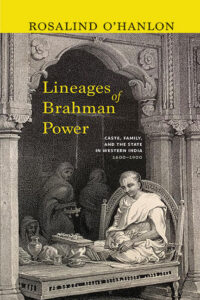
Rosalind O’Hanlon’s Lineages of Brahman Power: Caste, Family, and the State in Western India 1600-1900

Rosalind O’Hanlon’s Lineages of Brahman Power examines the ascent and transformations of Brahman communities in Western India (especially Maharashtra), from the 17th through the 19th centuries. The book traces how Brahman households, lineages, and networks negotiated power in relation to state, caste, law, gender, and knowledge. It emphasizes that “Brahman power” was not monolithic, but internally contested and evolving.
 Rather than taking “Brahman” as a fixed category, O’Hanlon shows its internal debates — subcastes competing, varying criteria for what constituted Brahminhood (ritual purity, scriptural knowledge, service to court/state, etc.). Family and lineage are not merely background but active sites for producing skills, cultural capital, networks, and claims to power. They helped Brahmans negotiate with states and society.
Some Brahman actors resisted social change and sought to conserve hierarchical caste, while others adapted by compromise, e.g. working with colonial regimes or adjusting norms. These dynamic tensions feed into later caste politics under colonialism and beyond.
The book is divided into thematic sections. Key chapters address:
-
Brahman Families in Motion
-
Speaking from Shiva’s Temple: Banaras Scholar Households and the Brahman “Ecumene” of Mughal India examines scholar‐households, their mobility, and how they constituted a Brahman ecumene under Mughal patronage.
-
Entrepreneurs in Diplomacy: Maratha Expansion in the Age of the Vakil shows how Brahmans acted as brokers/mediators in the expanding Maratha domain.
-
-
Family, Gender, and the State
-
How colonial and precolonial state authority interacted with the Brahman household (e.g. moral economy, disciplining households).
-
The case of Gotmai’s Suit examines a Brahman woman’s claim to property in 17th-century Western India, showing gendered legal and social norms.
-
-
Caste and the “Early Modern”
-
How networks of pandits (scholars), scribes, etc., legitimized themselves, sought livelihoods, and defined caste boundaries.
-
Comparisons between Brahmans and other literate castes, like Kayasthas, to explore social worth and competition.
-
Discourses over a long duration on social classification, including how Brahman identity was argued over in texts from c. 1400–1900.
-
-
Oral Traditions and Documentary Cultures
-
The role of puranic histories (oral or written) in crafting Brahman identity and communicating norms.
-
Petitions, litigations, and juridical culture (“presence of witnesses”) as public arenas where caste, status, and lineage were claimed or contested. How textual sources (Sanskrit/vernacular), oral histories, juridical documents, petitions etc., all serve both to legitimate Brahman power and to provide arenas of contestation.
-

+ There are no comments
Add yours